
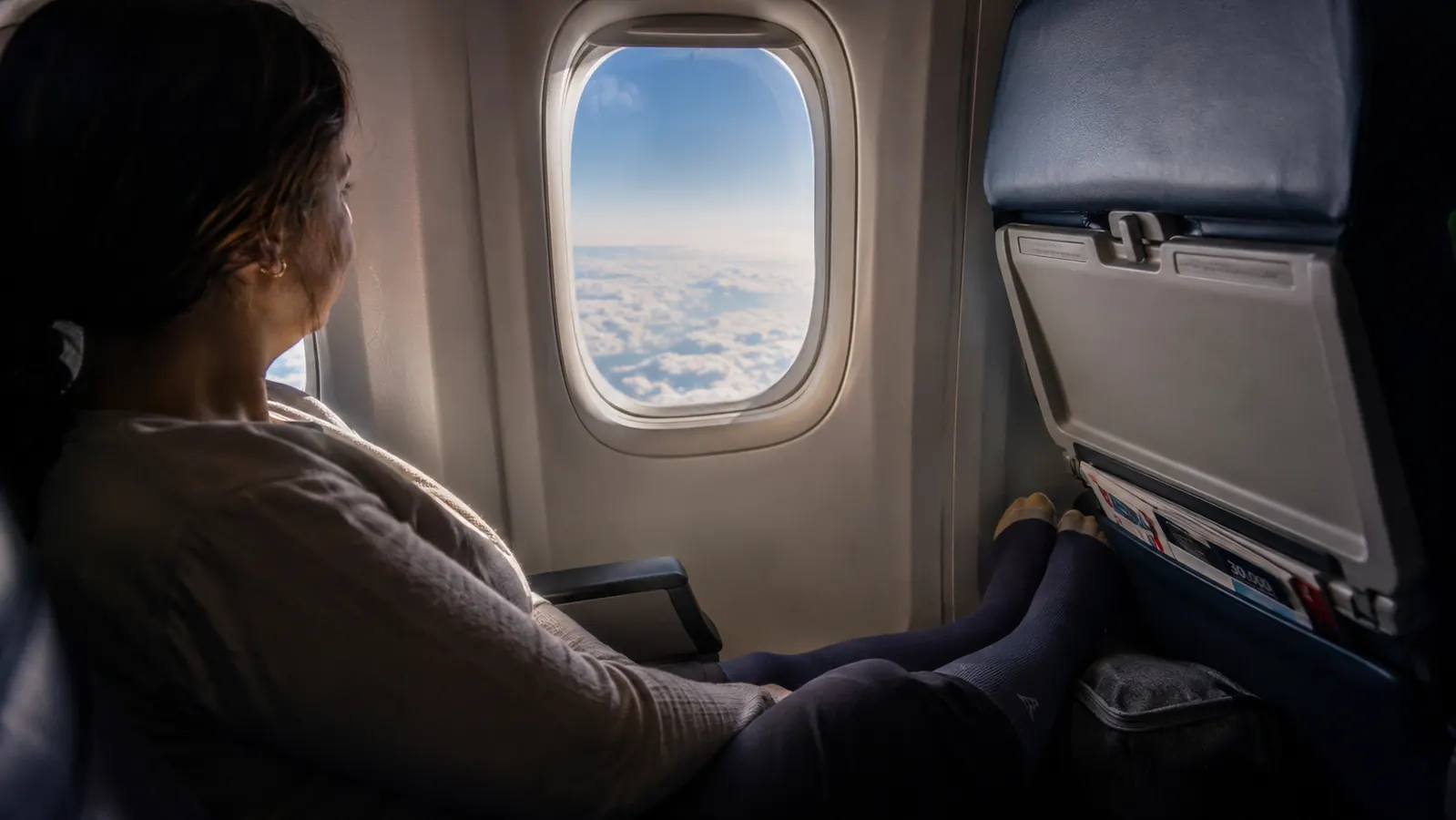
I stepped off a Los Angeles to Sydney flight a few years back and could not get my feet into my shoes. Not because I had overpacked them. Because my ankles had turned into something that belonged in a wildlife documentary. Fourteen hours in a middle seat, bad posture, two beers I should not have had, and zero preparation. I waddled through customs holding my shoes by the laces and told myself that was never happening again.
Since then I have ridden my motorcycle from Oregon to Baja, spent seasons on a 38-foot sailboat, and logged enough long-haul miles that most airline apps recognize my email address on sight. And I can tell you that swollen feet on landing are almost entirely preventable. Not with compression garments that cost more than the flight, not with some elaborate ritual, and definitely not with the vague advice to "stay hydrated" that appears on every airline health card. With a handful of specific steps you do before you board and a few moves you repeat in the air.
The sock I reach for every time I board a flight over four hours
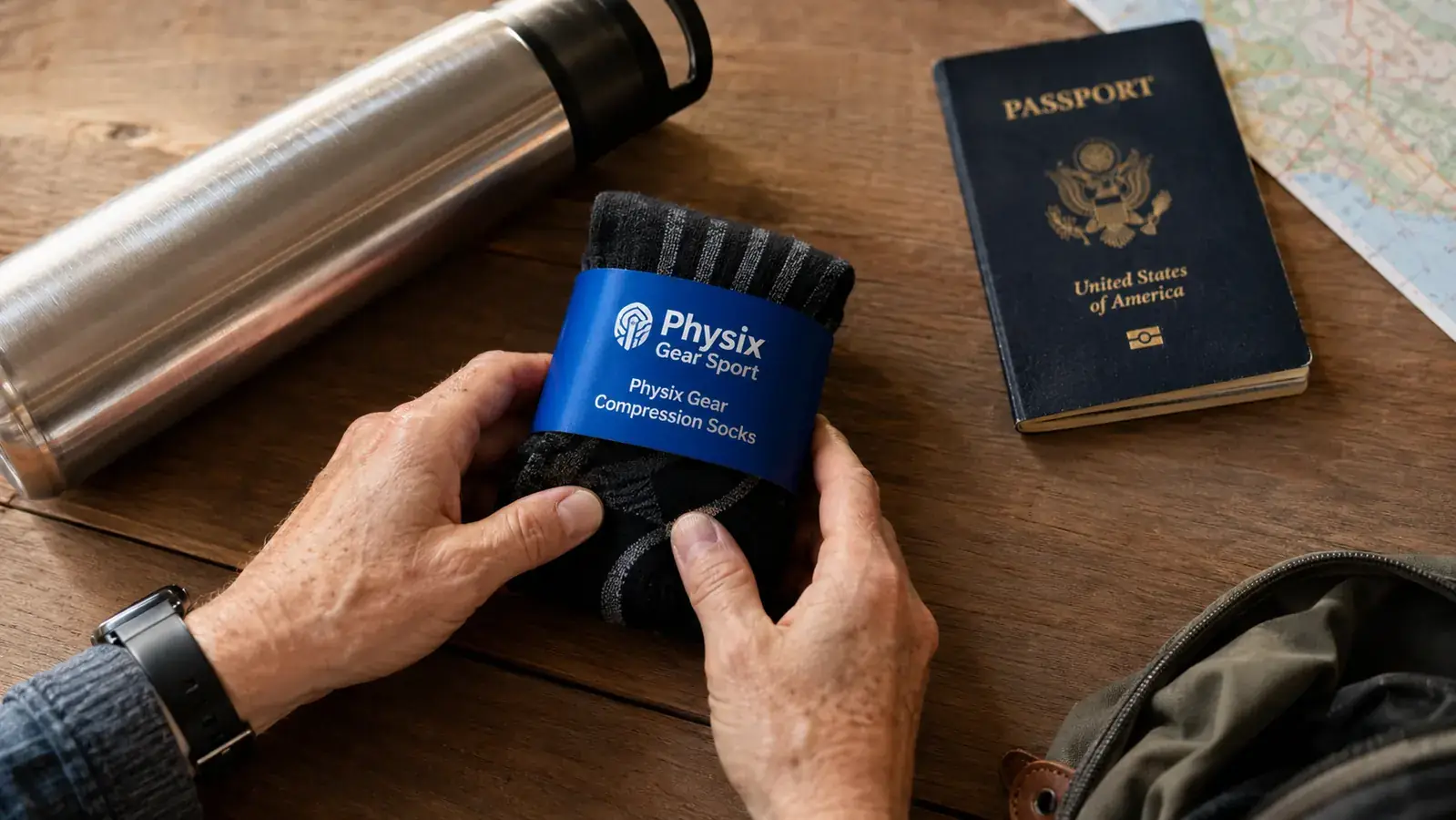
Physix Gear compression socks run 20-30 mmHg, the clinical sweet spot for travel swelling. Over 94,000 Amazon reviews and the pair I have worn on flights from LAX to Tokyo, Miami to Lisbon, and back again.
Amazon Check Today's Price on Amazon →One note before we get into it: if you have a history of deep vein thrombosis, heart or kidney disease, circulation disorders, or varicose veins, talk to your doctor before using compression socks or making changes to how you manage your health on flights. Everything in this guide is practical travel advice, not medical guidance. Your physician knows your situation and I do not.
Step 1: Put Your Compression Socks On Before You Leave the House
Most people pull compression socks out of their bag somewhere over the Pacific after their ankles have already started to swell. That is too late. Compression works by keeping blood and fluid from pooling in the first place. Once the swelling has started, a sock can slow it down but it cannot reverse it mid-flight. The window is before your feet reach altitude.
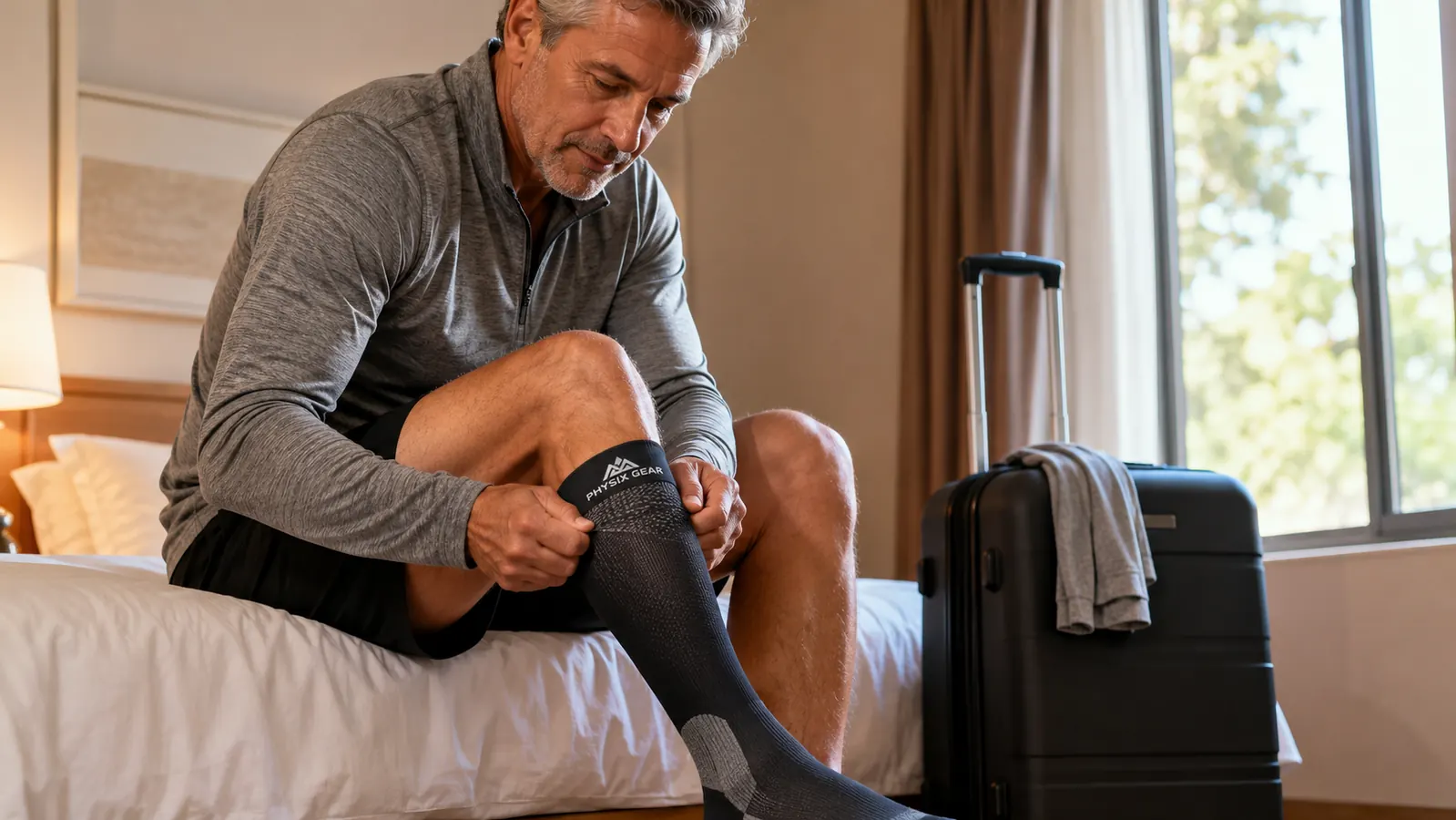
Put them on at home, before your body spends an hour in an airport terminal. Airport floors mean a lot of standing in lines, slow shuffling through security, and extended sits at the gate. All of that adds up before you have even boarded. If you are wearing Physix Gear compression socks at 20-30 mmHg, you are applying graduated pressure from the moment circulation is under any kind of strain. The 20-30 range is the one most often cited in travel medicine guidelines for economy class passengers with no underlying conditions. Lighter socks in the 8-15 range feel more comfortable but do less meaningful work on a 10-plus hour flight.
Sizing matters as much as compression level. A sock that bunches behind the knee cuts off circulation exactly where you do not want it cut off. Measure your calf circumference and your shoe size, not just your shoe size. Most brands including Physix Gear publish a two-dimension sizing chart. Take five minutes to get this right before ordering.
Step 2: Set a Movement Alarm for Every 90 Minutes
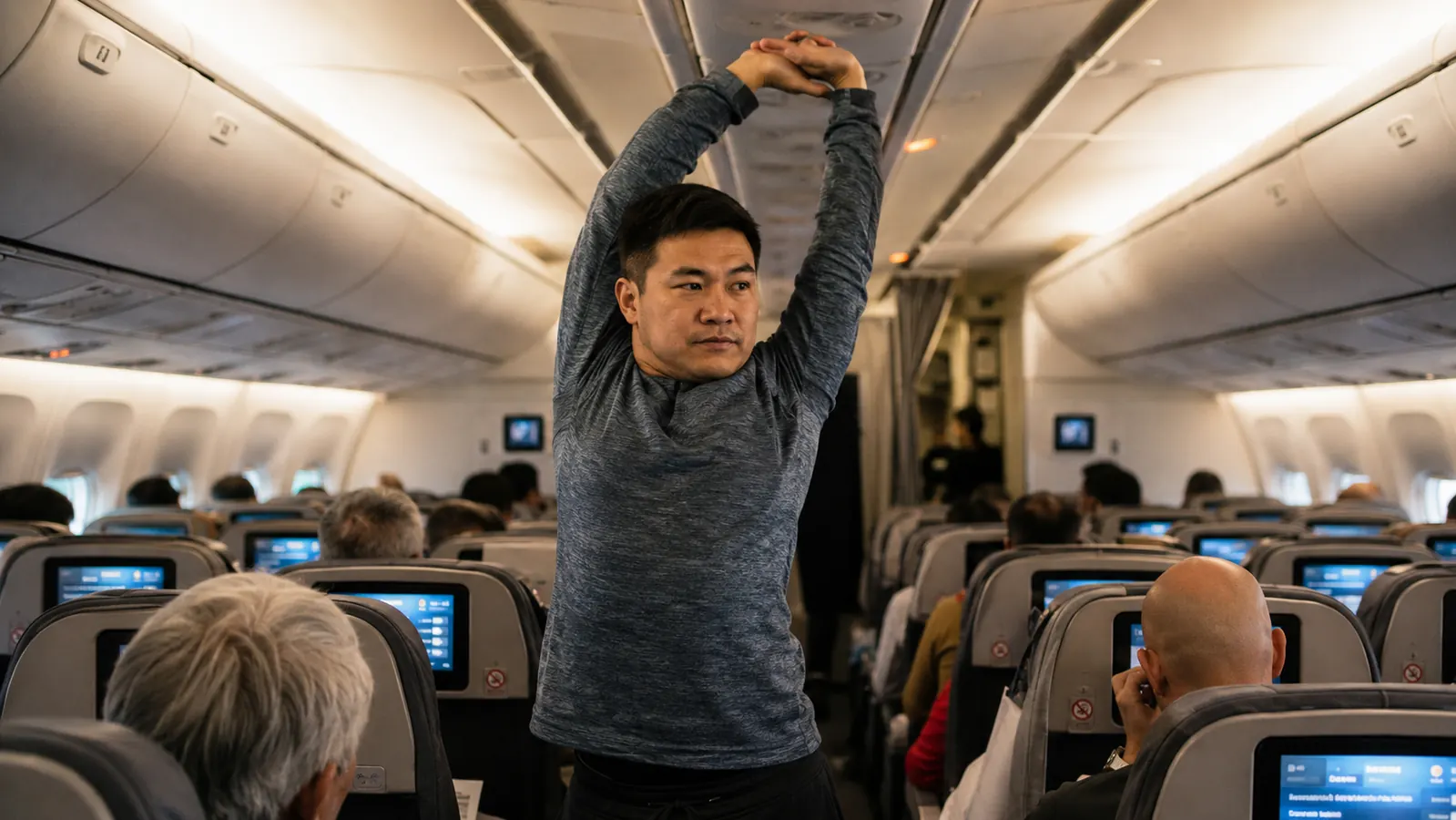
Your phone is already going on airplane mode. Before you flip the switch, set a repeating alarm for every 90 minutes labeled something useful like "walk and stretch." Then when it goes off, stand up. Not to get something from the overhead bin. Not to stretch your arms. Stand up and walk to the back of the plane, do a loop around the galley, and walk back. If turbulence has the seatbelt sign lit, you do the in-seat version instead.
The 90-minute mark is not arbitrary. Blood pooling in the lower legs from prolonged sitting becomes physiologically significant around that window. Standing and walking activates the calf muscle pump, which is your body's primary mechanism for pushing venous blood back up toward the heart. Even a two-minute walk does the job. What does not do the job is sitting still for seven hours because you did not want to disturb the person in the aisle seat. I have been that person in the aisle seat many times and I have never once minded someone climbing over me to walk the cabin.
Step 3: Do Four In-Seat Exercises While You Are Seated
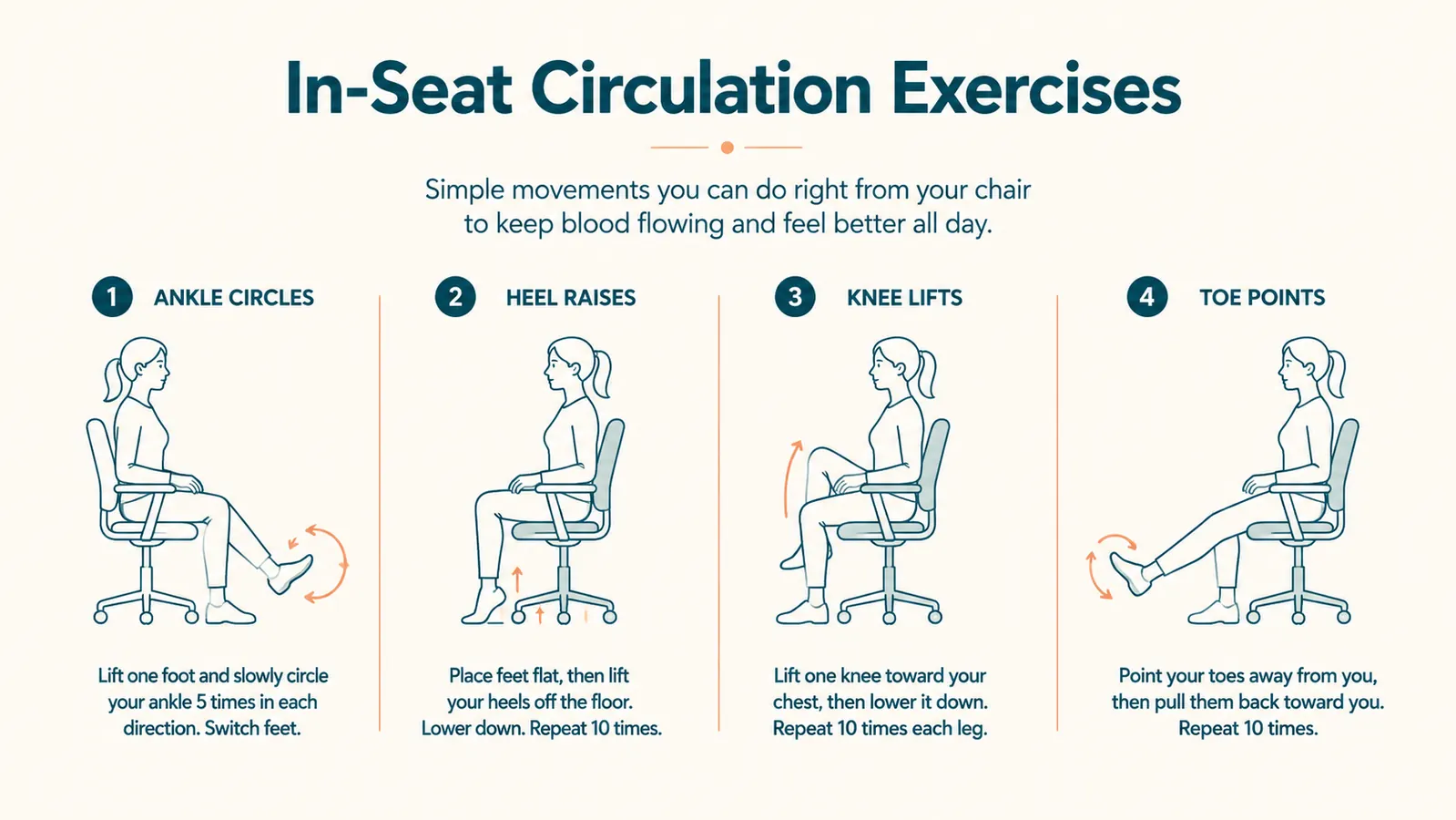
When you cannot get up, your legs can still do real work. These four moves take about three minutes and target the muscle groups responsible for pushing blood back toward your heart. Do them at least once per 90-minute window, more if you want.
Ankle circles: lift both feet slightly off the floor and rotate each ankle ten times clockwise, then ten times counter-clockwise. This engages the tibialis anterior and gets synovial fluid moving through the ankle joint. Heel raises: keep your toes on the floor and raise both heels as high as they go, hold for two seconds, lower slowly. Do 20 reps. This fires the gastrocnemius and soleus, your two primary calf-pump muscles. Toe points: extend both legs as straight as the seat pitch allows, point your toes hard away from you, then flex them back toward your shins. Alternate fast for 30 seconds. Knee lifts: seated upright, alternate lifting each knee toward your chest as high as cabin space allows, 15 reps per leg. This engages the hip flexors and gets the femoral vein moving.
None of these require any equipment or disturbing your neighbors. Do them quietly and nobody around you will notice. I do them during the parts of movies I have already seen.
Step 4: Manage What You Eat and Drink in the Air
Cabin air at cruising altitude runs at around 12 to 15 percent humidity, roughly the same as a desert. Your body dehydrates faster than you feel it, and dehydration thickens blood and makes circulation harder. That said, "drink more water" as a standalone tip is not enough because most people are already drinking some water and it is not the whole problem.
The things that make swelling significantly worse: alcohol, which causes vasodilation followed by fluid retention; high-sodium airplane meals, which pull fluid into tissue; and caffeine in large amounts, which has a mild diuretic effect. A single drink is usually fine for most people. Three drinks on an overnight flight followed by a salty meal and no water is a recipe for the kind of ankles that terrify customs agents. On longer flights I aim for roughly 8 ounces of water per hour of flight time and skip alcohol entirely when the flight is longer than eight hours. On shorter hauls I am less strict about it.
The calf-pump muscles only work when they are moving. A compression sock is the backup system when the muscles are doing nothing. Use both.
Step 5: Set Up Your Seat the Right Way Before Takeoff
How you sit matters more than most people realize, and the default economy-class position, slightly reclined with feet flat on the floor and no lumbar support, is basically designed to impede circulation in the lower leg. Two changes make a measurable difference.
First, do not cross your legs. Crossing at the knee compresses the popliteal vein running behind the knee joint. This is the same vein that surgeons worry about after knee replacement. Compressing it for eight hours while you sleep in an airplane seat is not doing you any favors. Sit with both feet flat or, better yet, elevated slightly on a small bag under the seat in front of you. Getting your feet even two or three inches off the floor reduces hydrostatic pressure on the ankle veins meaningfully. Second, if your seat reclines fully, use it during long sleep segments. A fully reclined position gets your legs closer to horizontal with your heart, which takes gravity partially out of the equation. The small amount of reclining that economy seats offer matters less, but it still beats the fully upright position for circulation.
If you have a long-haul flight coming up and you are on the fence about compression socks, I would put them at the top of the list before you bother with any footrest gadget or positioning pillow. They cost around what you pay for one airport sandwich and they do the one job that nothing else replicates: keeping graduated pressure on the venous walls from the toe to the knee, continuously, for the full duration of the flight.
What Else Helps
The five steps above handle the core problem. A few other things are worth adding once those are in place.
Compression socks work best when they fit. If you have not worn them before, try them on a shorter flight or a long car trip first. Some people find the initial pressure uncomfortable until their legs adapt. The discomfort should feel like firm pressure, not pain or tingling. Tingling means the sock is too tight or incorrectly sized and you need to check the fit.
Aisle seats give you more freedom to stand without waking anyone, which makes the 90-minute movement routine far easier to stick to. If you book early enough, the aisle is worth prioritizing for flights over six hours. Exit rows give you extra leg room but not necessarily easier aisle access depending on configuration.
After landing, even a 15-minute walk through the arrival terminal before you sit in another vehicle helps flush residual fluid. Airports are good for this. Walk from baggage claim to the car rental desk instead of taking the shuttle. Walk the long way to ground transportation. Your legs will thank you by the time you reach the hotel.
Finally, keep the socks on for an hour or two after landing if you are going directly from the plane to a car or train. Landing does not immediately reset your circulation. The pressure from a long flight lingers, and finishing the job with another hour in a compression sock before removing them is better than pulling them off at the gate and immediately stuffing your feet back into dress shoes.
If you want to dig into the specific features and durability of the socks I use, the full breakdown is in my Physix Gear compression socks review. And if you are trying to decide between brands, I compared them head-to-head in Physix Gear vs CHARMKING compression socks. Both pieces go deeper on construction, sizing, and what to expect after a year of regular use.
Ready to land with your feet in the same shape they were at boarding?
Physix Gear compression socks at 20-30 mmHg are what I wear on every long-haul flight. Rated 4.5 stars across nearly 95,000 reviews, available in multiple sizes and color options. Check current availability on Amazon before your next trip.
Amazon Check Today's Price on Amazon →