
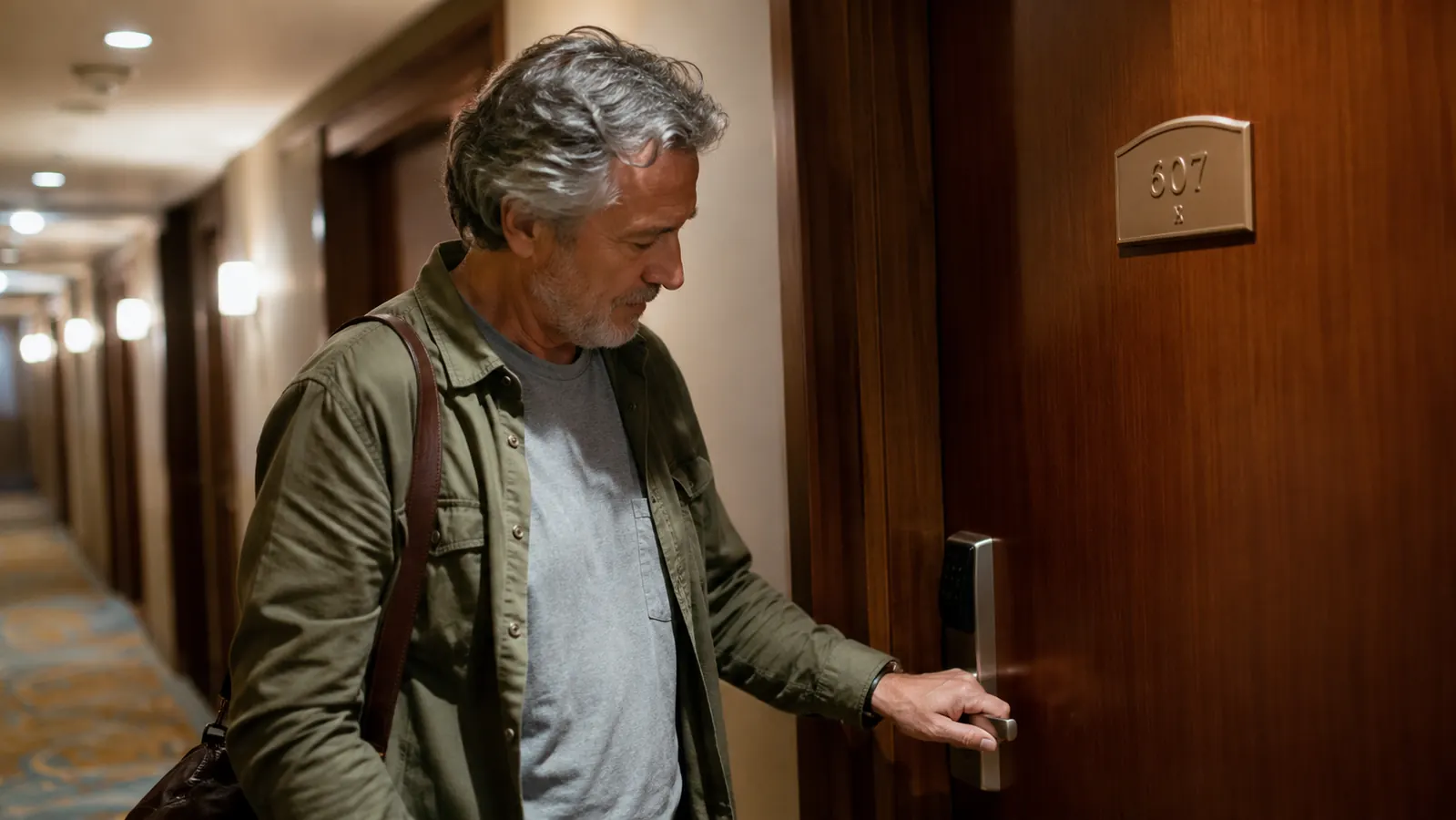
I have slept in a lot of rooms over the years. Budget hostels in Southeast Asia, middling business hotels in the American Midwest, rented cabins in Baja, and a marina slip that counted as a room only because it had a roof. In most of those places, the door lock told a comforting story that was not entirely true. A standard hotel deadbolt can be opened with a master key the cleaning staff use every day. A chain latch can be snapped off its housing with one solid shoulder. And the privacy bar, if the room has one at all, is usually a flimsy stamped-metal thing that gives way under pressure. None of this means hotels are dangerous. It means the lock on your door is a suggestion, not a guarantee, and once you understand that, you stop trusting it blindly.
The good news is that adding a real layer of security to any hotel room takes about thirty seconds and costs less than a meal at the airport. The Addalock portable door lock is the tool I reach for first. It fits in a jacket pocket, works on virtually any inswing door with a standard strike plate, and adds a mechanical barrier that cannot be bypassed from outside the room with any normal key. I carry one whenever I travel, whether I am in a four-star hotel or a roadside motel in the New Mexico desert. The steps below walk through exactly how to use it, and what else actually helps.
Your hotel deadbolt is not enough. This pocket-sized lock fills the gap.
The Addalock portable door lock works on almost any inswing hotel door, installs in seconds, and removes without a trace. Check current pricing on Amazon before your next trip.
Amazon Check Today's Price on Amazon →Step 1: Evaluate the Door Before You Unpack
Most people drop their bag, kick off their shoes, and start pulling out charging cables before they have even looked at the door properly. I spent a decade doing the same thing. Now I spend sixty seconds on a quick assessment before I do anything else.
First, look at the strike plate. That is the metal plate recessed into the door frame where the latch and deadbolt bolt engage. If it is loose, you can feel it wiggle when you push against the door. A loose strike plate means the door frame itself is weak and any lock on the door becomes much less effective. Next, check whether the deadbolt extends fully. Some older doors have warped frames that prevent the bolt from seating completely, leaving it partially extended and easy to defeat. Finally, check the chain or privacy bar. Pull it taut and see how much play it has. Some chains are long enough that the door can be pushed open two or three inches even when the chain is engaged, which is more than enough for someone to reach the interior handle and pop it off.
If the room has obvious problems, call the front desk and ask for a room change. That is not being difficult. That is basic trip planning. A two-minute call is far easier than an uncomfortable night. If the room checks out reasonably well, you still add your own layer. That is what the next step covers.
Step 2: Install the Addalock Portable Door Lock
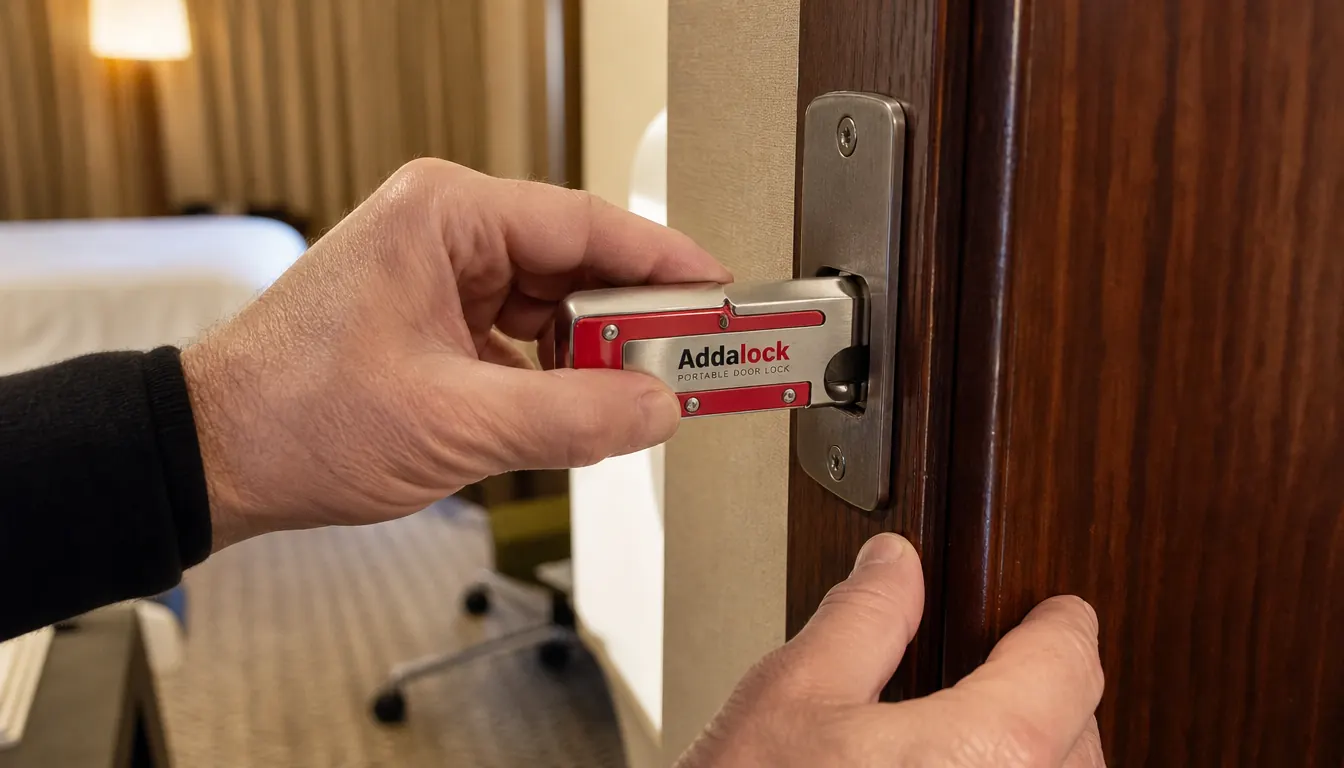
The Addalock is a two-piece stainless steel latch that works with the existing strike plate already built into your hotel door frame. You do not need tools. You do not modify anything. When you leave, the room looks exactly as it did when you arrived. Here is how to install it correctly.
Close the door and engage the standard deadbolt. Take the Addalock and insert the flat slot end into the latch opening of the strike plate on the door frame. The slot slides over the lip of the strike plate. Then fold the hinged arm of the Addalock down against the door surface. That arm acts as a physical stop that prevents the door from opening inward. No key, master or otherwise, can move that arm from the outside. The mechanism requires manual manipulation from inside the room to release it. When you are ready to leave, flip the arm up, pull the lock free from the strike plate, and put it back in your pocket. The whole process takes about fifteen seconds once you have done it twice.
One fit note: the Addalock requires a standard inswing door with a recessed strike plate that has an accessible lip. It works on the vast majority of American, European, and Asian hotel doors. It does not work on sliding doors, outswing doors, or doors without a traditional strike plate cutout. Check your door geometry on arrival. If the geometry does not cooperate, a door stop alarm (covered in Step 4) is your backup.
IMPORTANT SAFETY NOTE: Never use any portable door lock as a substitute for a functioning hotel fire exit. In a fire emergency, you need to be able to exit quickly. Practice the removal motion so it becomes automatic. The Addalock releases in one quick upward flip and takes no more than two seconds to pull free. Keep it within arm's reach of where you sleep, not in your luggage. And if your room is above the ground floor and lacks a fire escape window route, know where the stairwell is before you go to sleep.
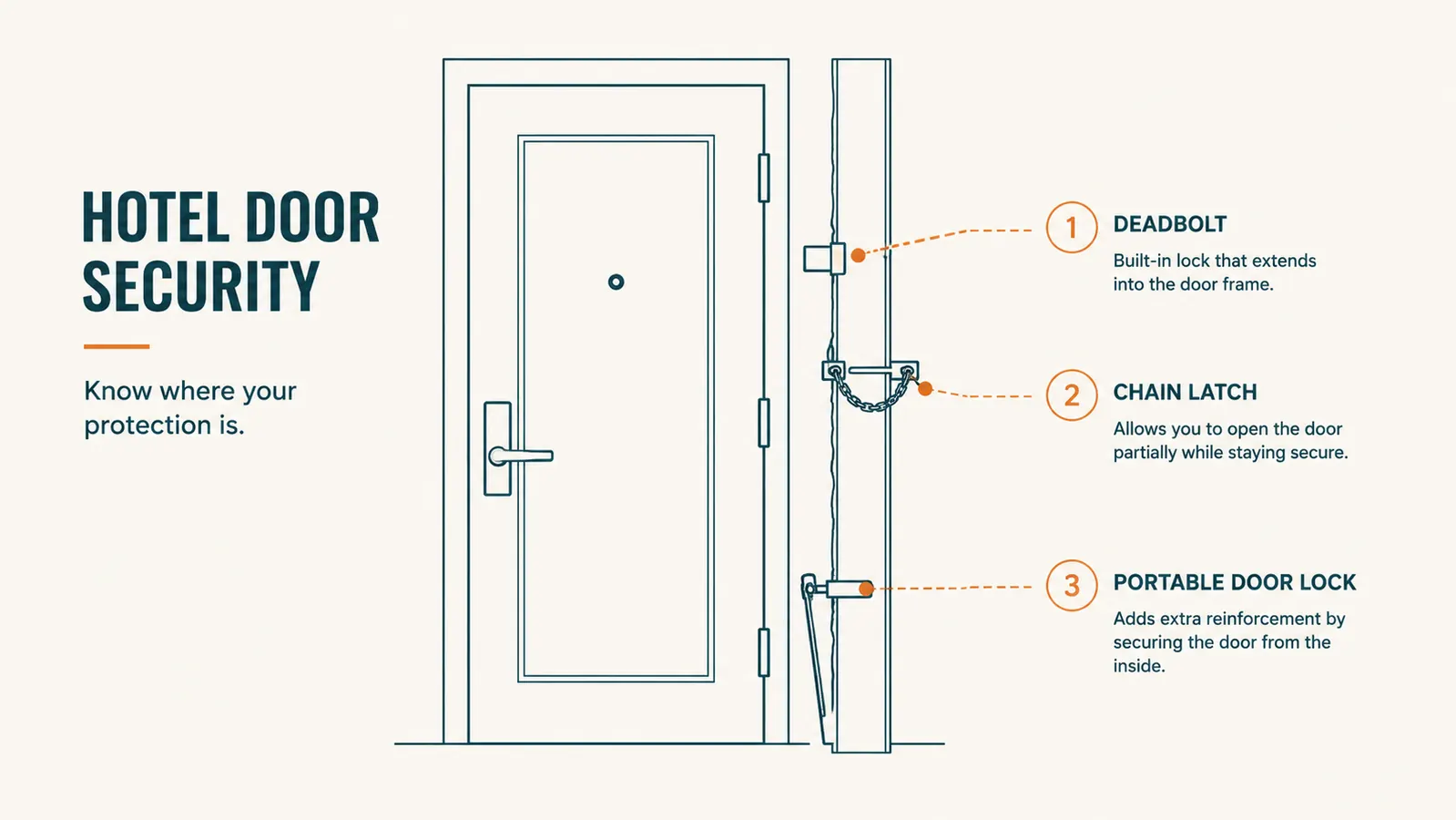
Step 3: Use the Deadbolt and Chain Together, Not Instead
Some travelers install the Addalock and skip the deadbolt, figuring one good lock is enough. That is the wrong approach. The portable lock works best as a supplement to the existing hardware, not a replacement for it. Use everything the room offers, then add the Addalock on top.
The deadbolt is your primary defense against someone walking in without intending to do harm, which is actually the most common scenario. A maid with the wrong room number, a front desk error sending someone to an already-occupied room, a drunk guest on the wrong floor. The deadbolt stops those situations entirely. The chain or privacy bar adds a secondary layer that tells anyone who opens the door that the room is occupied before they can fully enter. The Addalock then adds a mechanical stop that holds the door closed even if someone has a legitimate key and is intentionally trying to enter. Together the three layers cover every realistic scenario. Individually, each one has gaps.
On a boat or a bike, you learn fast that one lock is a suggestion and two locks are a system. Three locks, and you sleep.
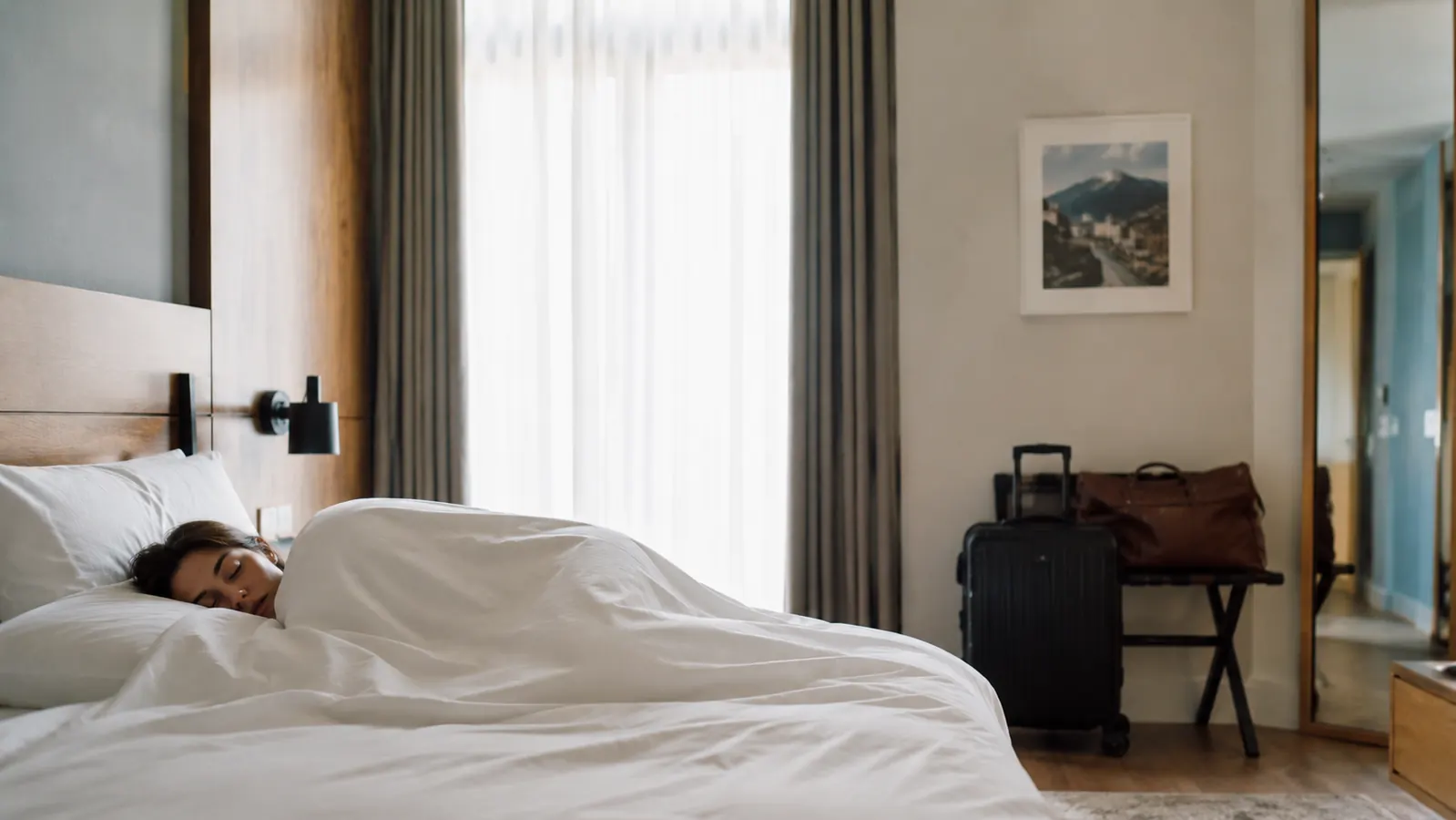
Step 4: Place a Door Stop Alarm at the Base of the Door
A door stop alarm is a wedge-shaped device you slide under the door gap. It does two jobs: it applies friction resistance against the door opening, and it triggers a loud alarm if the door moves. For rooms where the Addalock cannot fit the strike plate, a door stop alarm is the best mechanical backup. For rooms where it can, using both gives you noise as a secondary warning system.
Look for door stop alarms with at least 120 decibels of output. At that volume, the alarm is audible down the hallway and wakes most people from a sound sleep in under three seconds. The friction wedge alone is not enough to stop a determined entry, but the alarm buys you time and draws attention. On solo trips where I am in a room with one door and no balcony access, I always pair the Addalock with a door stop alarm. It adds almost nothing to my pack weight and covers the one scenario the Addalock cannot address: someone trying to open the door slowly and quietly, hoping I am not home.
Step 5: Manage Your Key Card and Room Number Carefully
The best door lock in the world does not help if someone knows your room number and can get a duplicate key issued. This sounds paranoid until you understand how easy it actually is at many properties. At lower-end hotels in particular, front desk security around key card issuance can be lax. Someone who approaches the desk claiming to be a guest and asking for a replacement key for room 214 will often get one with minimal verification.
Three habits close this gap. First, never say your room number out loud at the front desk during check-in. Ask the staff to write it on the key card sleeve and hand it to you quietly. Second, do not leave your key card in a wallet pocket next to credit cards. RFID-enabled key cards can interact badly with credit card skimmers in some crowded environments, and more practically, you simply do not want to lose your card in a busy venue and have your room number identifiable on the sleeve. Third, if you feel that someone has been watching your door or you have had an interaction that made you uncomfortable, request a room change or a re-key immediately. Hotels do this routinely and without making a scene.
This step costs nothing. It takes thirty seconds at check-in to establish the habit, and it removes the easiest social-engineering vector that bypasses every mechanical lock you brought.
What Else Helps
Beyond the five steps above, a few other habits are worth building into every hotel stay. None of these require extra gear.
Ask for a room away from the ground floor and away from the stairwell exit. Ground floor rooms have exterior window access and are statistically the most vulnerable. Stairwell-adjacent rooms get higher foot traffic from people who are not guests, particularly late at night. Floors two through five are a reasonable compromise between security and fire-exit accessibility. Above the fifth floor, elevator dependency becomes a factor in an emergency.
Use the do-not-disturb sign consistently, not just when you are sleeping. A visible do-not-disturb tag tells anyone in the hallway that the room is occupied. It also stops housekeeping from propping your door open while they clean, which happens more than the industry would like to admit. If you want fresh towels or a tidy room, call housekeeping and arrange a specific window rather than leaving your door unlocked and unattended.
Keep your valuables in the in-room safe if one is available, but remember that hotel safes are not impenetrable. Most are wall-mounted or furniture-mounted with standard override codes that cleaning staff use routinely. A portable travel safe or a slash-proof bag locked to a fixed piece of furniture is a stronger option for anything you truly cannot afford to lose, like a passport or a satellite communicator. For everything else, the in-room safe is a reasonable deterrent against casual opportunism.
If you want a deeper look at how the Addalock specifically performs over long-term use compared to competing portable locks, the full review at the link below covers everything from fit testing across different door types to hold strength under sustained pressure. There is also a side-by-side comparison against the SABRE portable door lock if you are weighing your options before buying. See the related reads: our Addalock long-term review and the Addalock vs SABRE comparison.
Thirty seconds to install. Works on almost every hotel door. Fits in a pocket.
The Addalock portable door lock has over 18,000 reviews for a reason. It is the fastest mechanical upgrade you can make to any hotel room, and it weighs almost nothing. Check today's price on Amazon.
Amazon Check Today's Price on Amazon →