
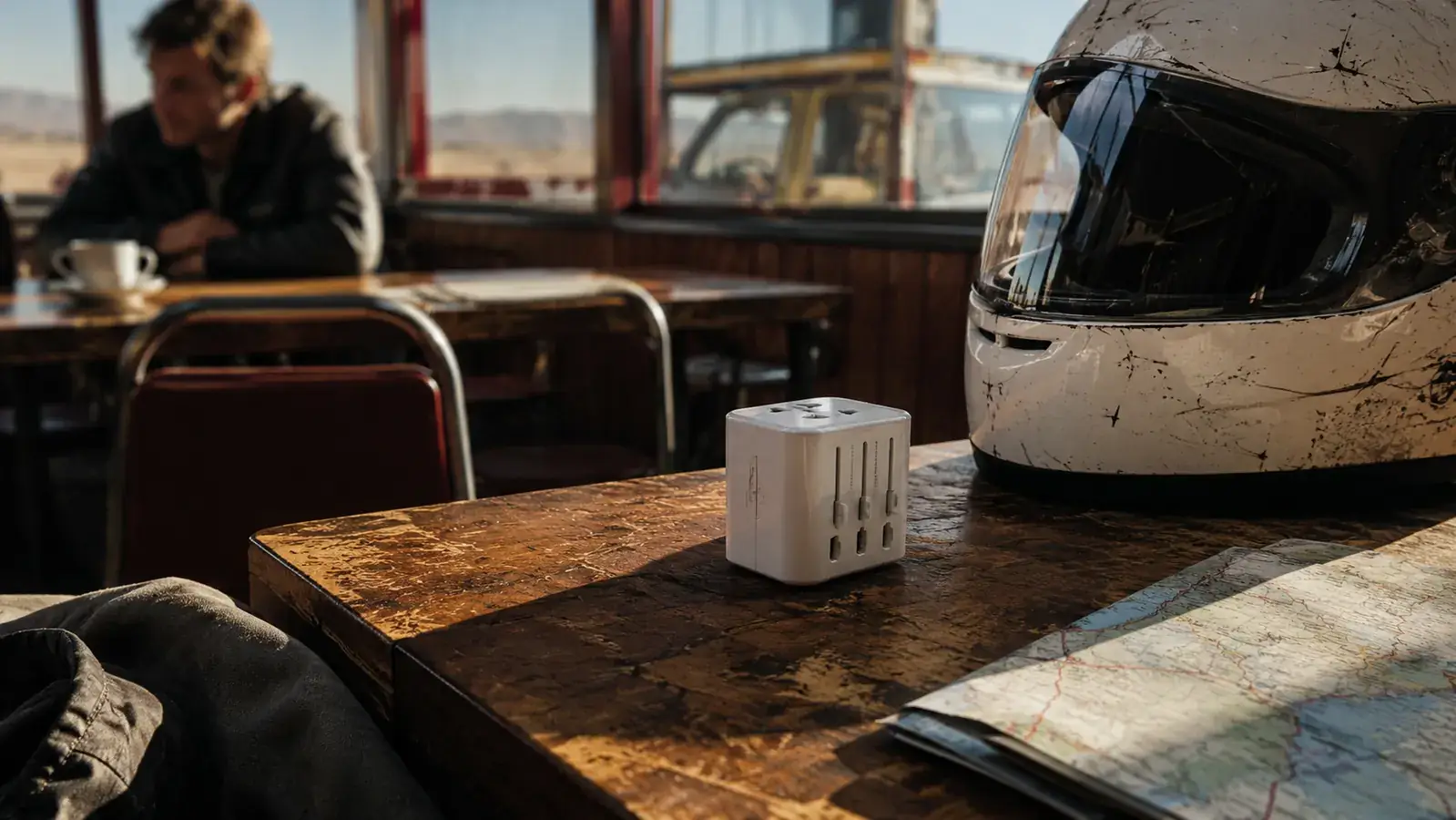
Most reviews of the EPICKA Universal Travel Adapter sound the same. They say it covers 150 countries, they like the USB ports on top, and they give it four or five stars. That consensus is not wrong, exactly. The EPICKA is a genuinely good adapter and I carry one. But there are five things the 4.7-star average glosses over, and if any one of them applies to your travel situation, you need to know before you pack.
I am Ray Calloway. Late fifties, early retired. When I am not on a bike I am on a boat, and either way I am hauling gear that has to earn its space. I test adapters the same way I test everything else: I push on what the marketing avoids. This piece is about the EPICKA's real weak points, not its obvious wins. If you want the long-term durability story, the other review covers that well. This one is about what nobody tells you upfront.
The Quick Verdict
A solid, compact adapter that does exactly what it claims, but with a 5W USB-C port, no voltage conversion, and a South Africa gap that some travelers will only discover at the outlet. Worth buying for most people. Not the right tool for every situation.
Amazon Check Today's Price →Pack the right adapter before you find out the hard way what your destination uses.
The EPICKA covers 150 countries in a package smaller than a deck of cards. Over 18,000 verified buyers. Check current availability and pricing before your next departure date.
Amazon Check Today's Price on Amazon -> →How I Put This Through Its Paces
My framing for this review is not long-term wear. It is stress-testing the specific claims. I bought a second EPICKA unit to run controlled charging tests in my workshop before a trip to Greece, and I spent four days running different device combinations through it to document what each port actually delivers under simultaneous load. Then I took that knowledge with me through Athens, Thessaloniki, and a three-day ferry run through the Dodecanese, where the electrical situation in some of the older guesthouses is a diplomatic fiction at best.
I also drew on conversations with two other long-distance travelers I know: a retired nurse who does medical volunteer trips in sub-Saharan Africa and learned the South Africa plug situation the hard way in Johannesburg, and a photography instructor who blew up a camera battery charger in Budapest because he misread the voltage question. Both stories appear below with their permission. I am not manufacturing problems the EPICKA does not have. These are real failure modes that real people hit.
The USB-C Charging Bottleneck Nobody Runs the Math On
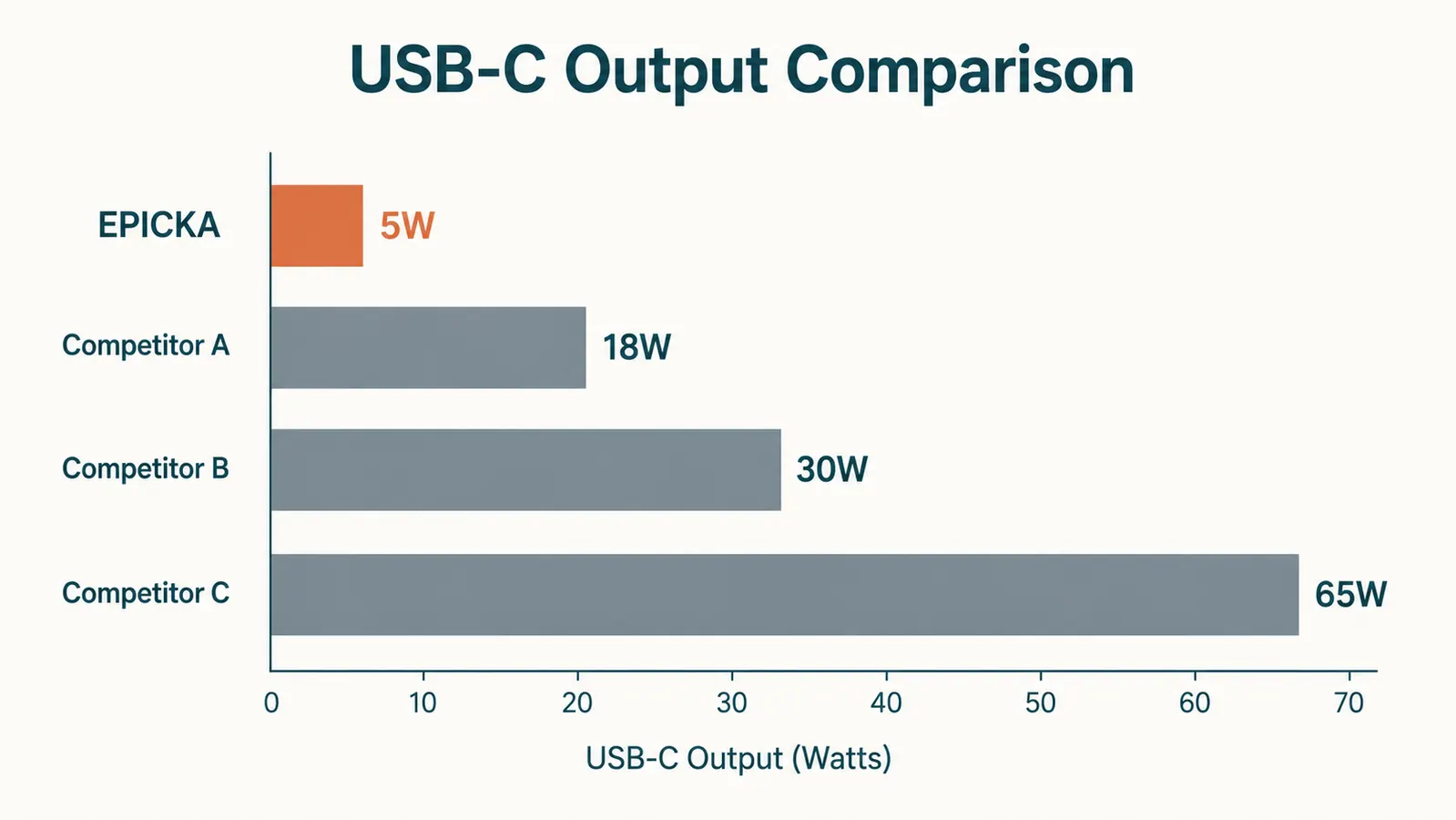
Here is the number that matters: the EPICKA's USB-C port outputs 5 watts. At 5W you can charge a modern iPhone from dead to full in roughly four and a half hours. A Samsung Galaxy flagship takes even longer. If you have a USB-C laptop, 5W will not charge it at all while it is running. It will barely offset the discharge if the laptop is asleep. That is not a minor footnote. That is the difference between waking up to a charged device and waking up to a device at the same percentage you left it.
Now stack the devices. Say you are traveling with a phone, wireless earbuds, a tablet, and a small USB-C reading light. You plug all of them in overnight. The four USB-A ports share 2.4 amps total across all four, which works out to roughly 12 watts split among them when everything is drawing at once. The USB-C port adds 5 watts. So your full simultaneous output from five ports is about 17 watts. On a good home charger, your phone alone gets 20 watts on its own. This adapter is not a replacement for a real multi-port fast charger. It is a plug converter with charging as a secondary feature. Understand that and you will not be disappointed.
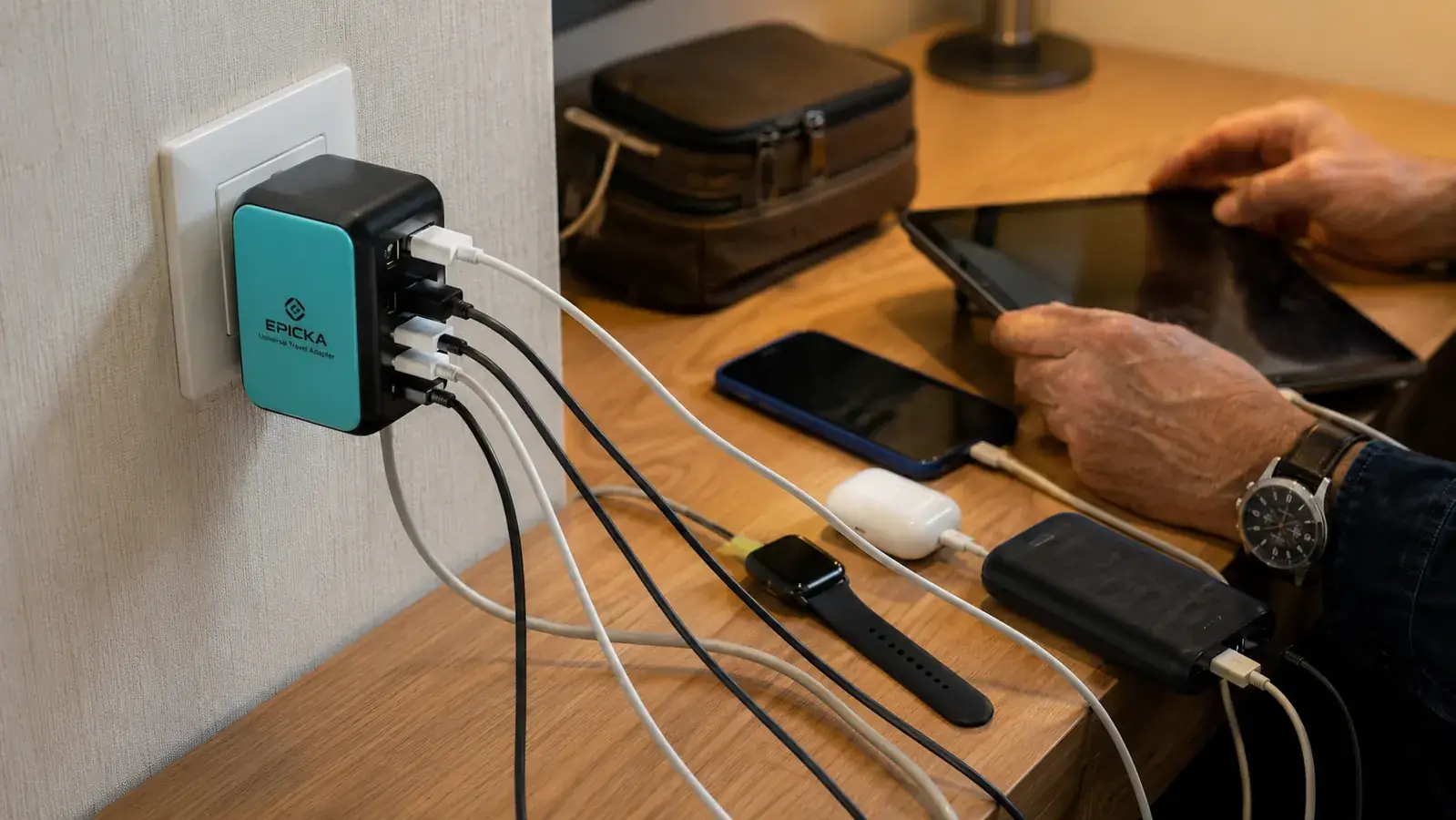
My workaround, and what I recommend to anyone traveling with a mix of USB-C devices, is to use the EPICKA's AC socket for your primary USB-C wall charger, the one that came with your phone or laptop, and use the built-in USB ports for lower-priority devices overnight. The adapter is an outlet multiplier as much as it is a charger. Once I reframed it that way the 5W port stopped bothering me. But you need to know going in. If you want a full breakdown of how to manage multiple devices on one adapter without losing your mind, the how to charge all your devices abroad piece has the full system.
The Voltage Conversion Trap That Still Claims Gear Every Year
The EPICKA is a plug adapter. It is not a voltage converter. That sentence is printed in the documentation, mentioned in the product title indirectly, and ignored by a meaningful percentage of buyers every year, including experienced travelers who should know better. The photography instructor I mentioned, ten years of international trips, still plugged his 110V-only battery charger into a 220V Budapest outlet through the EPICKA and destroyed it in about four seconds. The adapter did exactly what it was supposed to do. It let him connect a US plug to a European socket. What happened next was entirely the charger's fault for not being rated for dual voltage.
Every modern smartphone charger, laptop power brick, and camera USB charger is dual voltage. Look for the label that reads something like Input: 100-240V AC, 50/60Hz. If it says that, you are fine everywhere in the world. If it says Input: 110-120V AC only, do not plug it into a European or Asian outlet under any circumstances, adapter or no adapter. The things that still commonly come in single-voltage format: older electric shavers, some plug-in travel alarm clocks, cheap hair dryers, certain medical devices. Check every label before you go. The EPICKA will not protect you from your own single-voltage gear, nor should it. That is not what it was built to do.
The adapter did exactly what it was supposed to do. What happened next was the charger's fault for not being dual-voltage. The EPICKA gets blamed for a problem it cannot fix and never claimed to.
The South Africa Gap: Bigger Than It Sounds
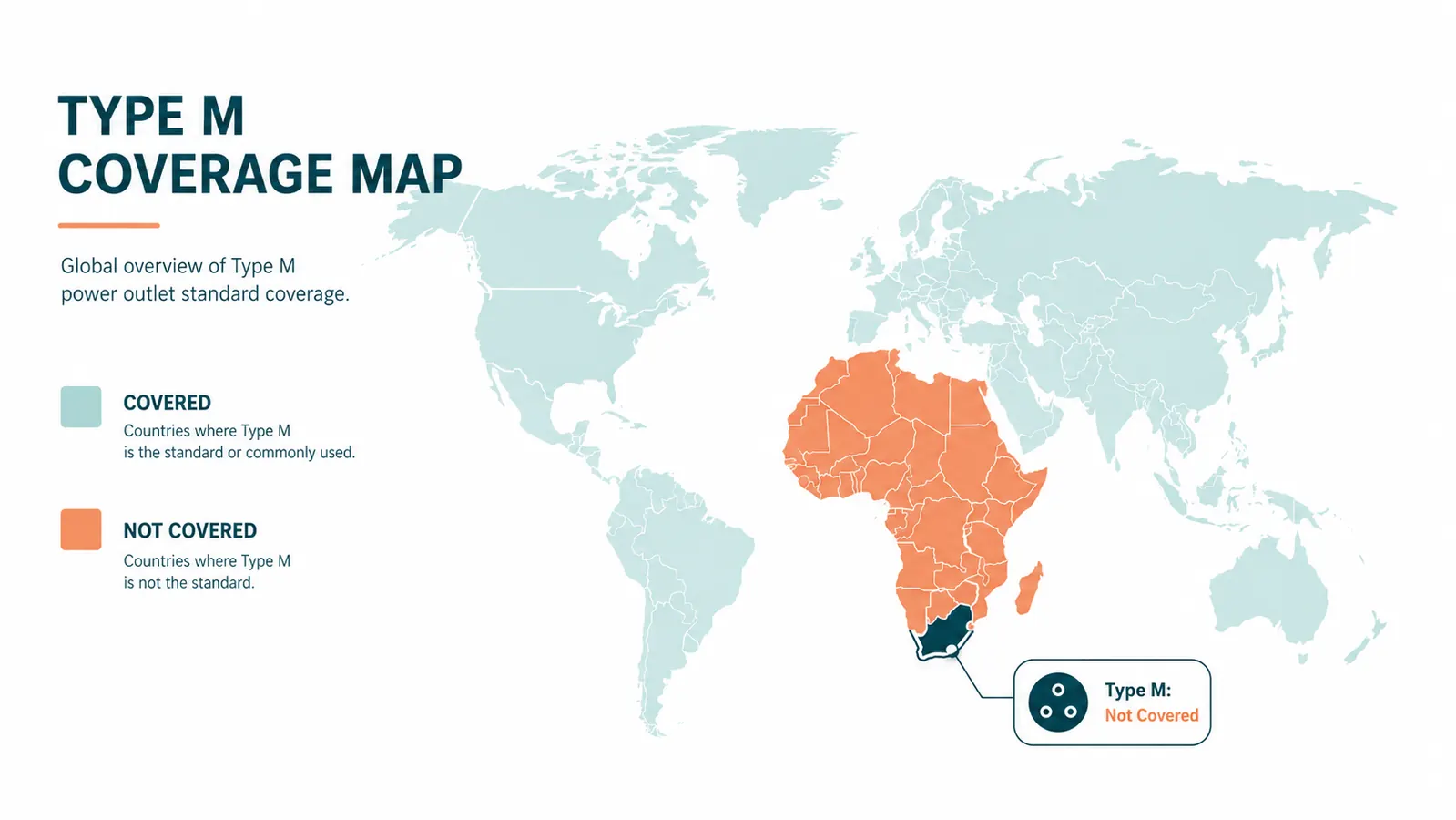
The EPICKA covers Type A through N, which sounds comprehensive until you look at what that list excludes. Type M, the large three-round-pin plug standard used in South Africa and a few neighboring countries, is not in the set. My contact, the volunteer nurse who runs four to six trips a year across southern and eastern Africa, found this out on her first Johannesburg trip when she went to charge her medical equipment battery pack and the adapter simply did not have a compatible socket configuration.
South Africa does have a lot of Type C outlets in newer hotels and guest facilities, so many travelers pass through without hitting the issue. But if you are staying somewhere older, somewhere rural, or somewhere that has not been renovated in fifteen years, Type M is what you will find in the wall. Ethiopia also uses Type M in many facilities. If your itinerary touches southern or eastern Africa, carry a dedicated Type M adapter in addition to the EPICKA, not instead of it. They are inexpensive and small. This is not a reason to avoid the EPICKA. It is a reason to know what you are getting.
Weight and Bulk When Every Gram Has a Reason to Exist
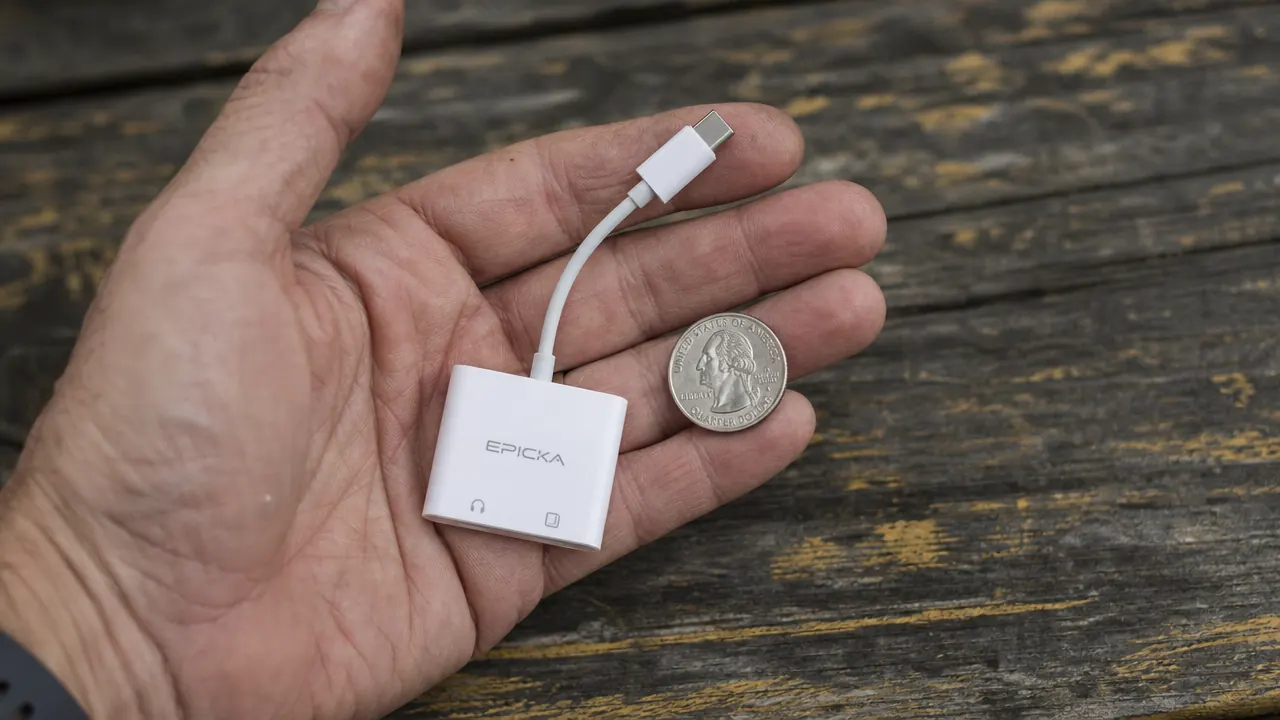
The EPICKA weighs roughly 135 grams and measures about 65 by 55 by 40 millimeters. For a hotel traveler that is no problem. For a motorcycle tourer or anyone running a hard-sided one-bag system, it deserves a look. On a bike my top case has finite space and everything competes against everything else for a slot. The EPICKA is not heavy by any reasonable standard, but it is denser than it looks. That cube shape does not nest particularly well with other flat gear. I have seen people try to carry two for redundancy, which at 270 grams combined starts to feel like a real number when you are watching your kit weight.
If you travel exclusively to one region, say only continental Europe or only Japan and Southeast Asia, a single-destination adapter that is roughly the size of a large coin will weigh less than half as much and take up a quarter of the space. The EPICKA earns its footprint when you are crossing plug-standard borders on a single trip. If you are not, the universal capability is deadweight you are hauling for no benefit. I keep one in my kit because I never know which marina or border crossing will surprise me with a nonstandard socket, and for that use case the tradeoff is worth it. For a two-week single-country vacation, a single-plug adapter makes more sense on the weight math.
The Fuse Situation and What Happens When It Trips
The EPICKA has a built-in resettable fuse rated at 6 amps. If you exceed that draw, the fuse trips and the adapter stops working. This is the right design. The problem is that most buyers do not know the fuse is there, do not know how to reset it, and assume the adapter has died when they exceed the load by accident. The reset button, a small recessed button on the side of the unit, brings everything back. Press it with a pen tip and the adapter works again. That information is in the manual, which most people toss without reading.
The 6-amp limit means roughly 660 watts on a 110V grid or 1380 watts on a 220V grid. You are not going to trip it charging phones and laptops. You will trip it if you try to run a travel hair dryer, a portable kettle, or a curling iron through it, all of which commonly exceed 1000 watts on their own. The adapter is rated for 1380W at 220V and 660W at 110V. Use it for device charging, not for small appliances, and the fuse will never factor into your life. But if you ever hand this to someone who does not know gear and they stuff a hair dryer into it, now you know what to tell them when it stops working.
What the Glowing Reviews Leave Out
The 4.7-star average from nearly 19,000 reviews is a real data point. That is not a paid-review number. It reflects genuine satisfaction from a huge sample of people who bought the adapter, used it on their trips, and came home with working devices. So I want to be clear: I am not trying to talk you out of it. I use one. The complaints I have described are not product defects. They are expectation mismatches that the product listing does not flag clearly enough.
What the reviews mostly do not cover: the USB-C math, because most reviewers never measure wattage and just assume it charged fast enough. The voltage trap, because the buyers who got burned by it tend not to leave reviews about their own mistake. The South Africa coverage gap, because the overlap between EPICKA buyers and South Africa travelers is small. And the fuse reset, because most people who tripped it either threw the adapter out or figured it out eventually without thinking to document the solution. None of these are hidden or deceptive. But a 4.7-star average is a weighted summary, not a complete picture. For a full side-by-side look at how the EPICKA compares to the TESSAN on these specific points, see the EPICKA vs TESSAN comparison.
What I Liked
- Covers 150 countries with a firm click-lock mechanism that does not wobble or retract under load
- Four USB-A ports plus one USB-C on top, all simultaneously usable while the AC socket is in use
- Compact cube form factor packs in a jacket pocket without bulk, genuinely smaller than alternatives
- Built-in resettable 6A fuse protects connected gear from overload, resets with a pen tip
- Safety shutters on the AC socket require simultaneous conductor insertion, reducing accidental contact risk
- 4.7 stars from nearly 19,000 reviews is a large, trustworthy consensus sample
Where It Falls Short
- USB-C port delivers only 5W, slow for modern smartphones and useless for laptop charging at speed
- No voltage conversion means single-voltage appliances are still at risk on foreign grids, adapter or not
- No Type M plug coverage leaves South Africa and parts of East Africa unserviced without a backup
- Cube shape does not nest flat with other gear, noticeable when packing a tight motorcycle top case
- Fuse reset button is not prominently documented, leading users to assume failure when load exceeds 6A
Who This Is For
The EPICKA is built for multi-country travelers who cross plug standards on a single trip and do not want to carry a fistful of destination-specific adapters. If your travel pattern includes stops in Europe, Asia, and the Americas on the same journey, it solves a real organizational problem in a small package. It suits people charging standard modern devices: smartphones, tablets, laptops via their own wall brick, earbuds, e-readers. Anyone traveling carry-on only who values the space savings will appreciate the size. And anyone who has been burned by cheap no-name adapters that wobble in the socket or deliver inconsistent current will notice the build quality immediately.
Who Should Skip It
Skip this adapter if you need direct USB-C fast charging at 20W or higher from the adapter's built-in port. Skip it if South Africa is your primary destination and you cannot find Type C outlets. Skip it if you are traveling to one country on a single itinerary and want the smallest possible adapter for that specific socket, where a flat single-plug adapter will weigh less and take up less space. And skip it if you plan to run any high-wattage appliance through it, because the 660W ceiling on 110V grids will trip the fuse and frustrate you. For everyone else, especially the frequent international traveler between 35 and 65 who just wants reliable power for their devices without logistics overhead, it earns its place in the bag.
Know exactly what you are buying before your next departure.
The EPICKA does what nearly 19,000 buyers say it does. If the limitations I described above do not apply to your trip, it is the right call at the current price. Check availability and see current pricing before you pack.
Amazon Check Today's Price on Amazon -> →