
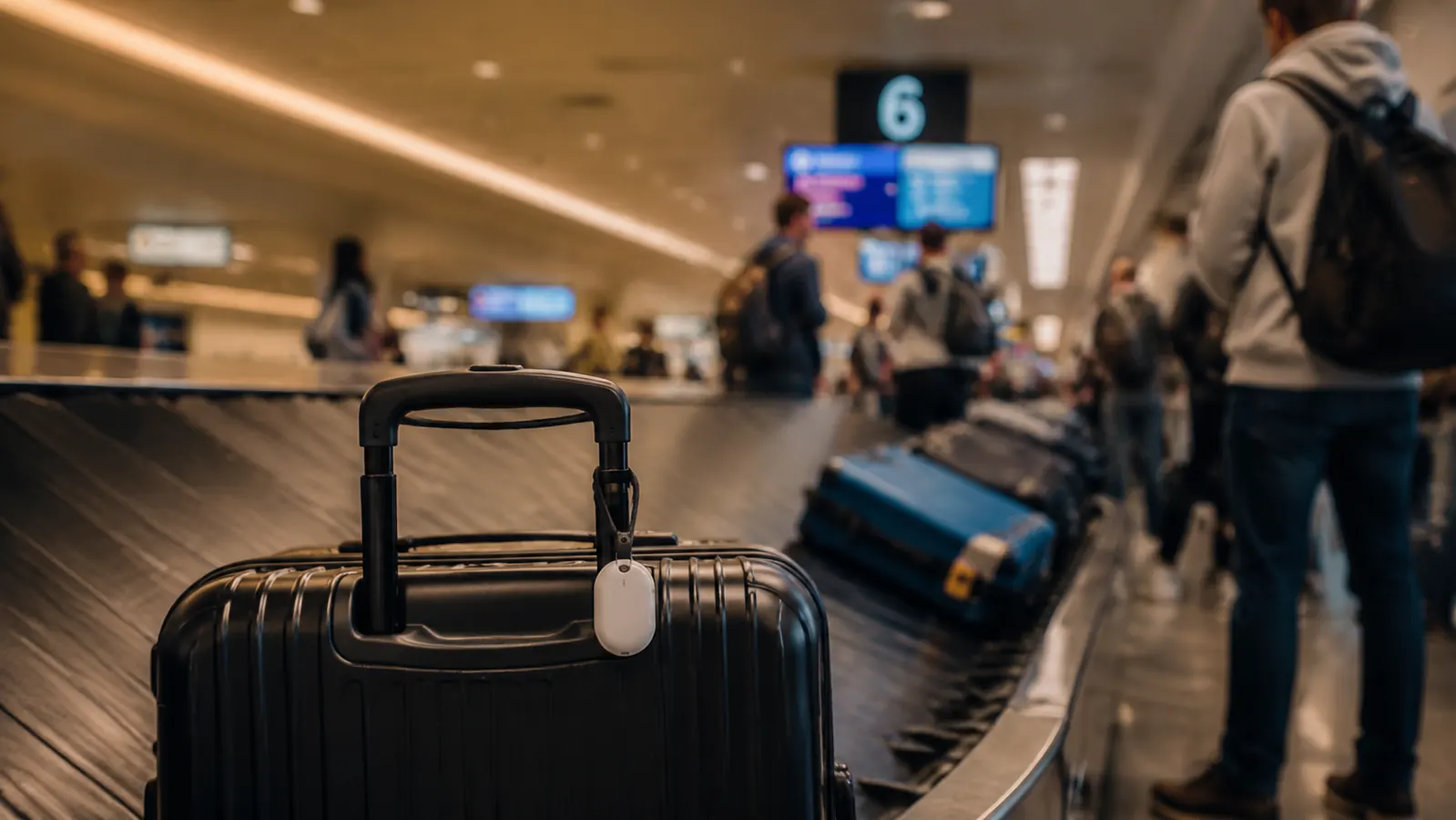
I have had bags routed to the wrong city twice in the last three years. The first time I had no tracker and spent four days in Lisbon borrowing clothes. The second time I had a Samsung Galaxy SmartTag2 clipped to the handle and watched the bag sit at a baggage handler facility in Madrid on my phone while I was still at the gate. I had a hotel address to give the airline within ten minutes. Those two trips are the entire case for carrying a luggage tracker, and they are also the entire context for this comparison.
The question people actually ask me is whether the Samsung SmartTag2 or the Apple AirTag is better for tracking luggage. The short answer: the phone already in your pocket decides it. The SmartTag2 runs on Samsung's Galaxy Find network and requires a Samsung Galaxy phone to get the most out of it. The AirTag runs on Apple's Find My network and requires an iPhone. If you try to use either one with the wrong phone, you are leaving most of the functionality on the table. But there are real differences in battery life, water resistance, network density, and precision finding that matter for travelers, and those are worth walking through carefully.
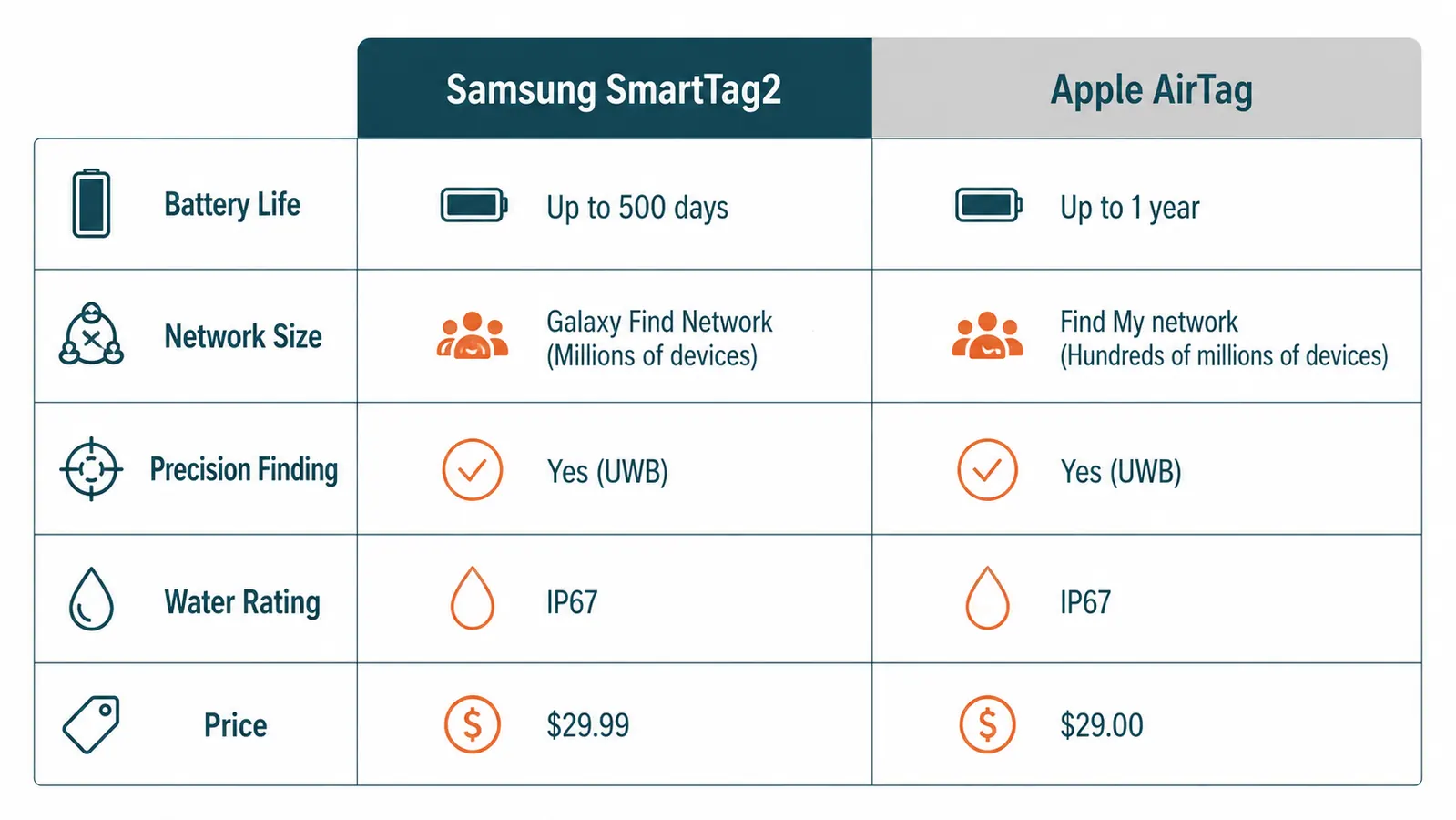
| Samsung SmartTag2 | Apple AirTag | |
|---|---|---|
| Required Ecosystem | Samsung Galaxy (Android) | iPhone (iOS) |
| Location Network | Galaxy Find network (Samsung devices) | Apple Find My network (all Apple devices) |
| Estimated Network Size | ~500 million Samsung Galaxy devices | ~2 billion Apple devices |
| Battery Life | Up to 500 days (replaceable CR2032) | Up to 365 days (replaceable CR2032) |
| Precision Finding | Bluetooth direction finding (audible beep) | Ultra-Wideband (UWB) with on-screen arrows + haptics |
| Water Resistance | IP67 (1 meter, 30 minutes) | IP67 (1 meter, 30 minutes) |
| Lost Mode | Alerts you when tag is found by any Galaxy device | Alerts you when tag is found by any Apple device |
| Anti-Stalking Alert | Alerts nearby Galaxy users of unknown tags | Alerts nearby iPhone + Android users of unknown tags |
| Current Price | Single unit | Standard single unit pricing |
Where the SmartTag2 Wins
Battery life is the first real advantage. Samsung rates the SmartTag2 at up to 500 days on a single CR2032 coin cell battery when you are using Normal power mode. That is about four to five months longer than the AirTag's rated 365 days in typical use. For a traveler who clips this thing to a bag and forgets about it for a year, that gap matters. I replaced my SmartTag2 battery once in fourteen months of heavy use. I have heard from iPhone users who replaced their AirTag battery twice in the same window, though usage patterns obviously vary.
Price is the other clear win. The SmartTag2 runs lower at current Amazon pricing, sometimes even less when a coupon is clipped. The AirTag sits higher for a single unit. If you are outfitting a family of four with trackers for every piece of luggage, that per-unit difference adds up fast. The SmartTag2 also comes in four-packs that bring the per-unit cost down further. For Android households, especially Samsung Galaxy households, there is simply no reason to pay AirTag prices for the same basic job.
Your bag is in the wrong city. The SmartTag2 shows you exactly where.
At a competitive price per unit and 500-day battery life, the Samsung Galaxy SmartTag2 is the practical pick for Android travelers who are tired of filing missing bag reports blind. Check current Amazon pricing and availability.
Amazon Check Today's Price on Amazon →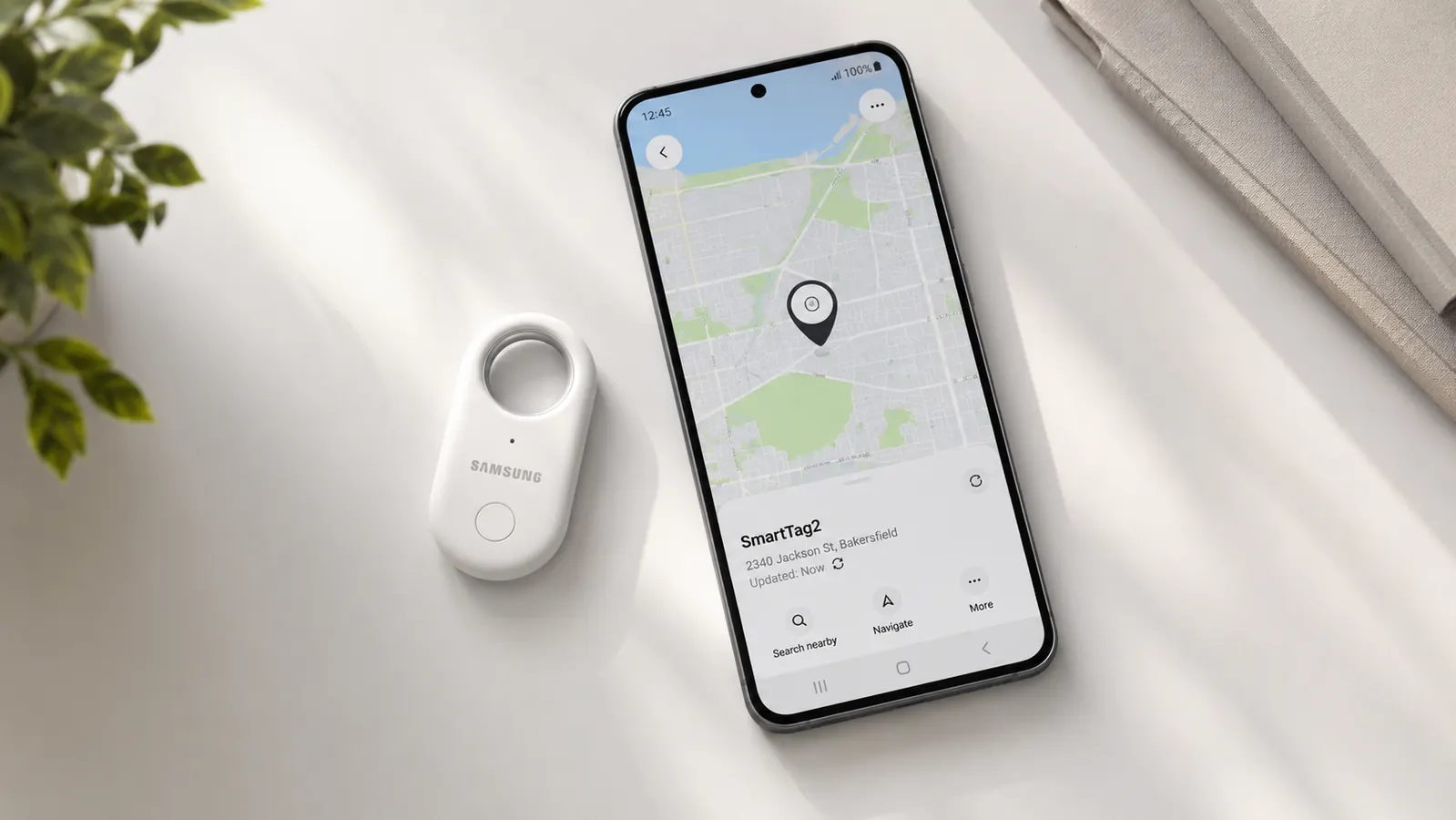
Where the AirTag Wins
Network size is Apple's big card. Apple has somewhere in the neighborhood of two billion active devices in the wild. Every iPhone, iPad, Mac, and iPod touch running a recent version of iOS or macOS is silently, anonymously reporting the location of nearby AirTags back to their owners. Samsung's Galaxy Find network is large by any objective measure, around 500 million Galaxy devices, but it is still dwarfed by Apple's footprint. In dense urban environments and major airports, the practical difference is small. In rural areas, developing countries, or destinations where Android dominates but Samsung Galaxy specifically is less common, the network gap becomes meaningful.
Precision finding is where AirTag pulls ahead in pure technology terms. AirTag uses Ultra-Wideband (UWB) hardware to give you on-screen directional arrows and distance readouts when you are within Bluetooth range, letting you walk directly toward a lost bag in a baggage claim hall with the phone pointing the way. The SmartTag2 relies on Bluetooth direction finding and an audible beep, which is fine but less precise. If your bag ended up behind a pillar in a crowded carousel area, the AirTag experience is noticeably smoother. That said, UWB requires a compatible iPhone model, and not every AirTag owner has one that actually delivers the full precision-finding experience.
Network size is Apple's big card, but 500 million Samsung Galaxy devices is not a small net to cast, especially at the international airports where bags tend to go sideways.
The Network Question for International Travel
This is where I have to be honest about what I have actually observed, not just what the spec sheets say. I travel a fair amount through Southeast Asia, parts of Central America, and a handful of African coastal ports. In those regions, Android is dominant overall, but Samsung Galaxy specifically varies city to city. On the flip side, Apple's Find My network is more consistent in Western European airports and major hubs in Asia. For travelers who stick to routes through London, Tokyo, Sydney, Paris, or major US airports, either network is dense enough to do the job. For travelers who venture into less-traveled corridors, neither tracker is a guaranteed recovery tool. Think of it as a strong lead, not a guarantee.
One practical note: both trackers work best when you pair them before leaving home, register them in their respective apps, and enable Lost Mode before you check a bag. The tracker does not send real-time GPS. It pings its location when another device in the network passes near it. At a busy airport with hundreds of devices in every terminal, that ping can happen within minutes. In a quiet warehouse on a cargo route, it might take hours or not happen at all until the bag moves. Setting expectations correctly is part of using either device well.
Anti-Stalking and Privacy Protections
Both companies have worked to address concerns about trackers being used for stalking. Apple alerts nearby iPhone users and, through a separate Android app, Android users when an unknown AirTag has been traveling with them. Samsung alerts nearby Galaxy users about unknown SmartTags. Neither system is perfect, but both have improved significantly since their initial launches. For travelers, the more relevant point is that if someone slips a tracker into your bag without your knowledge, there is at least a chance your phone will tell you. AirTag's cross-platform Android alert app gives it a slight edge here in terms of reach, but the practical protection on both sides remains limited.

Physical Design and Travel Durability
Both devices are IP67 rated, meaning they can handle a meter of water for thirty minutes. That is adequate for a bag going through a rainy tarmac or a boat bilge. The SmartTag2 has a built-in keyring hole, which makes attaching it to a luggage handle, zipper pull, or bag strap simple without buying any additional accessory. The AirTag is a smooth disc that requires a third-party holder or loop to attach to anything. The SmartTag2 is slightly larger but has a more practical out-of-the-box attachment story. For travelers who want clip-and-forget convenience, the SmartTag2 wins the form factor round.
Weight is nearly identical. The SmartTag2 comes in at about 13 grams. The AirTag is around 11 grams. Neither will register on a luggage scale in any meaningful way. Both are replaceable-battery devices, which I consider a feature. Nothing is worse than a tracker that requires proprietary charging hardware when you are mid-trip and the battery dies. The CR2032 is available at airport convenience stores in most of the world, and swapping it takes about ten seconds.
Who Should Buy Which
If you carry a Samsung Galaxy phone, the SmartTag2 is the straightforward answer. You get native integration with the SmartThings Find app, full precision-finding capability, the longer battery life, and a lower per-unit price. There is no version of that setup where the AirTag makes more sense, regardless of what you have read about Apple's network size. The SmartTag2 on a Galaxy phone is a complete, well-integrated system. Buying an AirTag as a Galaxy user means accepting a stripped-down experience with no precision finding and slower location updates.
If you carry an iPhone, the AirTag is the cleaner choice for most travelers, particularly on high-traffic routes through Western Europe, North America, and East Asia where Apple's network is dense. The precision-finding experience with UWB is genuinely useful at baggage claim, and the Find My integration is seamless. The higher price is real but not unreasonable for what you get. If you travel frequently to regions where Apple devices are less common, know that the AirTag's effectiveness diminishes accordingly, just as the SmartTag2's effectiveness diminishes in regions where Samsung Galaxy is less common.
For households that carry both Android and iPhone devices across multiple travelers, the honest answer is to match each tracker to the phone that will be monitoring it. A SmartTag2 on a Galaxy phone is a better experience than an AirTag on a Galaxy phone, and vice versa. For more context on long-term SmartTag2 performance, see my full Samsung SmartTag2 review from a year of travel use. And if you are starting from zero and want a step-by-step on setting up a tracker before your first trip, the luggage tracker setup guide covers the whole process.
Samsung Galaxy user? This is the tracker to clip on your bag before the next flight.
The Samsung Galaxy SmartTag2 runs in the budget range, lasts up to 500 days on a single battery, and integrates natively with the SmartThings Find app on any Galaxy phone. It is the practical choice for Android travelers who want real-world tracking without paying Apple prices.
Amazon Check Today's Price on Amazon →